

Topical Sunless Tanning (SIK Inhibition): The Next Generation of UV Prevention Therapy
-
For over 20 years, reaching for a vial of Melanotan as soon as summer hits has been standard practice in the fitness and biohacking worlds. But as anyone here knows, MT2 comes with serious baggage - from systemic side effects like nausea and flushing to rapid, alarming changes in existing moles and freckles (new and old).
This post explores a completely different biological angle - specifically looking at a compound called GLPG3312. This post also aims to highlight who would be interested in joining a group buy for this very compound.
What is a SIK Inhibitor?
A SIK (Salt-Inducible Kinase) inhibitor is a small-molecule compound that triggers natural skin tanning without UV light or DNA damage. Inside your pigment cells (melanocytes), SIK enzymes act as a constant molecular brake that stops the cell from making melanin when you aren't in the sun. This brake sits on the differentiation pathways, and NOT the growth pathways.
Applying a SIK inhibitor topically temporarily releases that brake, allowing a messenger protein called CRTC3 to enter the cell's nucleus and activate MITF - the master genetic switch for melanin production. The result is genuine, photoprotective eumelanin (a real biological tan, not a dye), even in fair or red-headed skin types that normally only burn.
This mechanism was validated in 2017 by dermatology researchers at Harvard and Massachusetts General Hospital (MGH) studying Fitzpatrick Type I skin. Normally, UV light triggers the surface MC1R receptor on melanocytes to shut off the SIK brake. In redheads and many fair-skinned people, the MC1R receptor is mutated and non-functional, leaving the SIK brake permanently locked on. Because everyone still possesses the intact downstream machinery to produce dark brown eumelanin, applying a topical SIK inhibitor bypasses the faulty MC1R receptor entirely, successfully inducing a real eumelanin tan in MC1R-deficient models and human skin explants. Whilst achieving this it also has huge anti-inflammatory properties, alongside the suppression of MMP enzymes which are responsible for chewing up collagen and elastin in your skin.
Currently, there is a company called Soltego who have patents on ultra potent pan SIK inhibitors for tanning, and anti aging. The catch? They are trying to market them as cosmetics, and as such their timelines have continued to push back over the years as they quite clearly grapple with regulatory bodies.
Why could this be a better (and safer) alternative to Melanotan?
Melanotan is a systemic peptide injection that stimulates the upstream MC1R receptor across your entire body, flooding every mole and pigment cell with raw cAMP (a growth signal). That whole-body cAMP surge fires both differentiation (tanning) and secondary growth/migration pathways (like EPAC, ERK etc..) simultaneously, which is why users frequently experience nausea, facial flushing, rapid mole darkening, and eruptive growth in old sunburn-damaged moles.
A topical SIK inhibitor stays localised to the upper layer of skin and works much further downstream, skipping raw cAMP and growth pathways entirely to trigger only the CRTC > MITF differentiation and DNA-repair switch. In healthy skin and "half-asleep" moles where your natural tumour-suppressor brakes (p16) are still intact, differentiation acts as a natural growth lock: instead of pushing cells to multiply, it enforces those remaining brakes to keep damaged cells locked still while speeding up UV DNA repair. Unlike Melanotan - which pours fuel on pre-cancerous moles by firing upstream growth pathways, SIK inhibition recruits the cell's remaining p16 brakes to lock damaged melanocytes in a safe, non-dividing state. It only becomes a risk in full-blown melanoma (which accounts for 1-3% of all skin cancers), where those genetic brakes are already destroyed and the oncogenic cascade can no longer be contained - at which point stimulating either proliferation or differentiation only fuels the tumour's survival. In non-melanoma skin cancers (BCC and SCC), the cells lack the MITF pigment switch entirely—meaning SIK inhibition actually acts as a cytostatic brake in pre-cancerous keratinocytes by boosting p21/p27 and blocking PAI-1.
The other huge benefit to SIK inhibition? Downstream targeting also produces a much more even tone if you have freckles or past sun damage. Because Melanotan relies on the surface MC1R receptor, which is often weak or irregular in fair, burn prone skin - it hyper stimulates dense clusters of melanocytes (freckles and moles) way faster than the surrounding pale skin. Bypassing MC1R with a SIK inhibitor turns on protective eumelanin uniformly across the background skin between freckles, blending your complexion evenly instead of just making your moles and freckles pop.
Enter GLPG3312 - what is it?
GLPG3312 is a potent pan-SIK inhibitor originally developed by Galapagos to target autoimmune and chronic inflammatory conditions like rheumatoid arthritis (RA) and IBD.
It passed pre-clinical assays and successfully completed Phase 1 human safety trials. However, likely due to a short half-life (which is actually ideal for a topical application) and high serum protein binding, Galapagos pivoted to a sister compound (GLPG3970). That program was eventually shelved too, while lowering SIK successfully reduced pro-inflammatory cytokines (TNF-alpha) and boosted anti-inflammatory cytokines (IL-10), complex autoimmune conditions like Rheumatoid Arthritis proved too multi-faceted for a single mechanism.
Why GLPG3312 Works for Sunless Tanning
Both Soltego's lead compound (SLT-048) and the Galapagos series are ATP-competitive SIK inhibitors. Because they have to outcompete intracellular ATP to bind to the SIK enzyme, they need to be extraordinarily potent. Both SLT-048 and GLPG3312 are highly potent across all three isoforms (SIK1, SIK2, and SIK3) and are nearly identical in potency on SIK2, the primary driver of melanogenesis.
However, raw potency in a test tube isn't enough for a topical. To traverse the human skin barrier, a compound has to satisfy four strict pharmacokinetic rules:
- Molecular Weight (< 500 g/mol): Must sit below the 500 Da threshold so it isn't too bulky to squeeze through the stratum corneum.
- Balanced Log P (2.0 – 3.0): Measures lipid vs. water affinity. Too hydrophilic and it sits on the surface; too lipophilic and it gets trapped in the oily top layer instead of entering the living epidermis below.
- Electrical Neutrality: Must remain un-ionized across the skin's acidic pH gradient. Charged molecules get repelled by the lipid barrier or pulled into the acidic lysosomes of upper skin cells (ion-trapping) before reaching basal melanocytes.
- Vehicle Solubility: Must dissolve cleanly in a skin-compatible carrier so it doesn't crystallise on the surface as inactive "brick dust."
Property SLT-048 (Soltego) GLPG3312 (Galapagos) Size 540 g/mol (Unfavourable) 454 g/mol (Ideal) Log P ~2.85 (Ideal) ~2.85 – 3.2 (Ideal) Neutrality 99% Protonated (Unfavourable) 99% Neutral (Ideal) Solubility Soluble (Ideal) Soluble (Ideal) Concentration & Trial Safety Margins
In Soltego's patent data, SLT-048 was tested at concentrations between 0.2% and 2%. Factoring in GLPG3312's lower molecular weight and electrical neutrality across skin pH, dermal penetration modeling suggests a 0.1% to 0.15% concentration of GLPG3312 delivers an equivalent active payload to the melanocytes as 2% SLT-048.
To put the systemic safety margin into perspective: a 0.1% benchmark equates to 1 mg of active compound per mL (around 30 mg for a full-body 30 mL application). Since typical dermal absorption sits between 3% and 5% (and rarely exceeds 10%), systemic exposure models at roughly 0.3 mg to 3 mg, and realistically under 1 mg.
While Galapagos didn't unblind exact milligram labels for the 14 human cohorts in the GLPG3312 Phase 1 trial, reconstructing the dosing from their preclinical animal data (0.3–30 mg/kg) and follow-on benchmarks places the top-end human oral trial dose at roughly 400 mg daily. That means even a full-body topical application results in systemic exposure 100 to 1,000 times lower than the oral clinical ceiling.
Is GLPG3312 Better Than Soltego's Molecule?
On paper, yes - it is smaller, far more skin-permeable, and matches SLT-048 in SIK2 potency.
The primary difference is regulatory design. Soltego engineered SLT-048 as a "soft drug," meaning once it enters tissue and blood, it is rapidly broken down by esterase enzymes. Soltego built this self-destruct mechanism in because they are pursuing a cosmetic regulatory pathway; if an active molecule survives systemically, regulators classify it as a pharmaceutical requiring full clinical trials.
While GLPG3312 isn't an esterase-cleaved soft compound, the systemic concentration needed to exert an internal effect is vastly higher than what absorbs from a 0.1% topical application. Furthermore, because GLPG3312 has such a short intrinsic half-life, Galapagos actually had to formulate modified-release tablets just to keep it active in their Phase 1 oral trial - any trace amount that reaches the bloodstream is cleared by the liver fairly quickly, with no systemic build up.
Has any of this actually been shown in real skin?
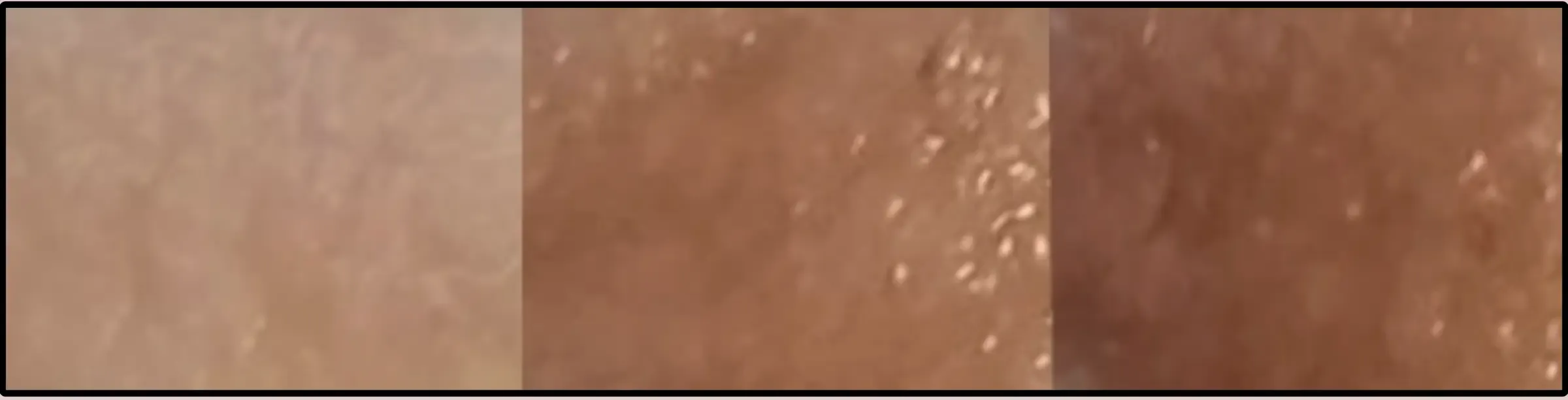
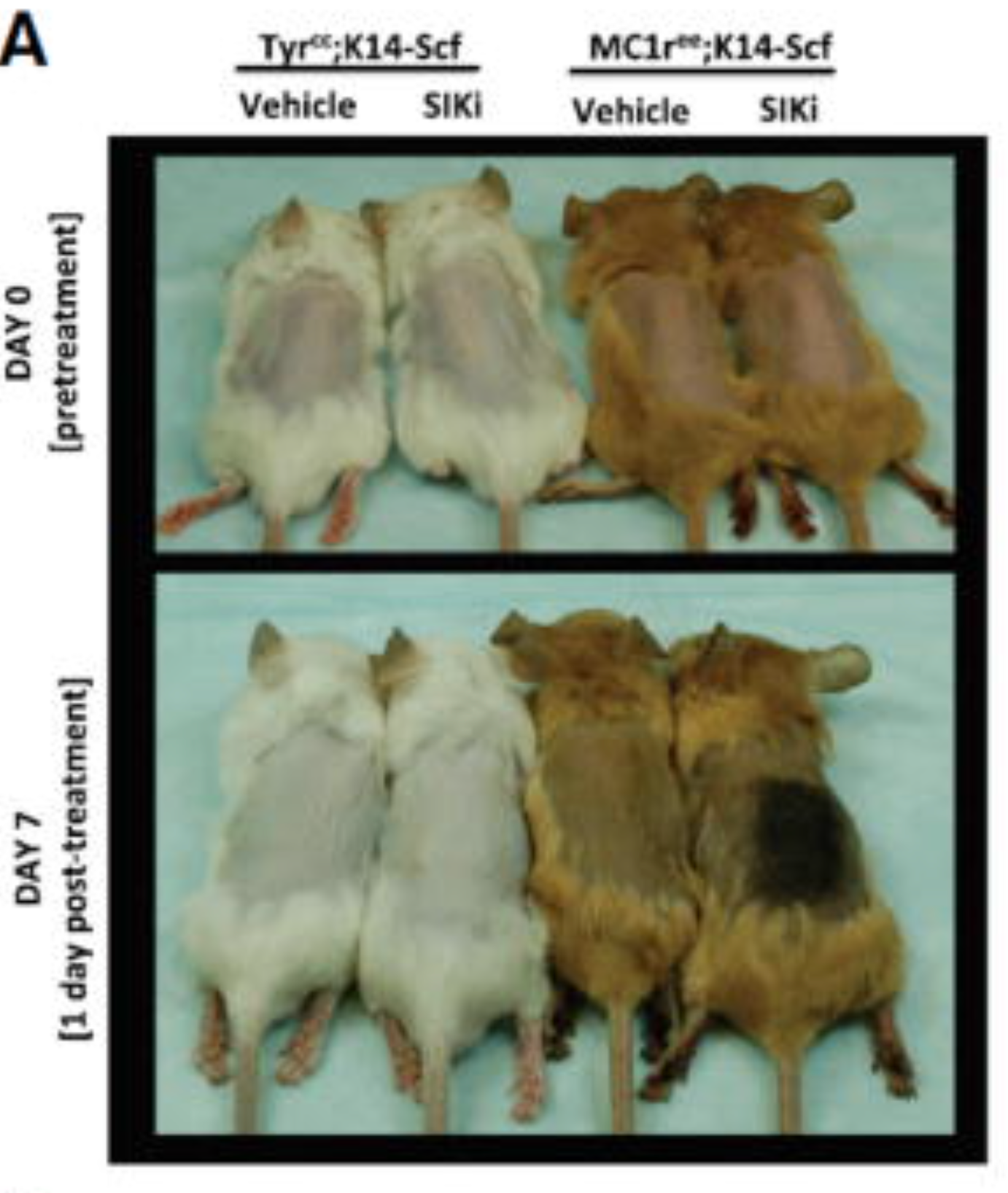
Yes! Whilst the original studies back in 2017 were on mice (very thin skin). Real skin explants were released last year to demonstrate the change on human skin.
The initial mouse results using a compound called HG-9-91-01 can be shown here. With the treated mouse turning black by day 7.
The most recent human skin imagery released last year by Soltego can be seen here. Very exciting..

Are there any other benefits of inhibiting SIK in the skin?
Beyond melanin production and DNA repair, topical SIK inhibition doubles as a potent anti-inflammatory and anti-aging mechanism. On the immune side, inhibiting SIK2 allows CRTC3 to enter the nucleus of local macrophages, shifting them out of their destructive pro-inflammatory state - dropping inflammatory cytokines like TNF-alpha and IL-12 while boosting tissue-soothing IL-10. On the structural side, this directly combats "inflammaging" and photoaging. UV exposure and chronic skin inflammation normally crank up MMPs (Matrix Metalloproteinases, like MMP-1 and MMP-9), the enzymes responsible for chewing up dermal collagen and elastin, as well as PAI-1, a classic marker of skin-aging "zombie" (senescent) cells. By suppressing PAI-1 expression, calming inflammatory macrophage activity, and shielding the dermis from UV-triggered MMP spikes, SIK inhibition actively preserves the skin's collagen matrix while it tans you.
How would anyone know how to synthesise GLPG3312?
Well, luck would so have it that in 2024 a full paper was published on it. Defining both the compound itself, as well as its fully detailed synthesis. Of which i will link.
https://pubs.acs.org/jmcmar/article-pdf/67/1/380/11806592/jm3c01428.pdf
Do you have any personal reservations about SIK inhibition?
Originally, i was worried about eye colour change. SIK inhibition drives MITF, which in turn drives the production of tyrosinase - the enzyme that produces pigment in melanocytes. My concern was that this could permanently darken your eye colour, especially since your iris doesn't shed and turn over pigment the way skin cells shed a tan.
However, for those of us with blue or pale eyes (which I’d imagine is the majority of those seeking a tanning aid), there’s a built-in biochemical roadblock (HERC2 > OCA2 > melanosomal pH). For tyrosinase to actually work, the acidic interior of the melanosome has to be neutralised. People with pale eyes have a mutation in the HERC2 switch that controls OCA2, meaning the OCA2 pump stays shut off in the iris and can't raise the pH to the threshold tyrosinase needs. As a result, the iris melanosomes stay acidic, which not only keeps tyrosinase inactive, but actually degrades any extra tyrosinase that gets produced.
On top of that, no human SIK inhibitor clinical trials have reported any eye colour changes.
What should we know about you?
I am a true type 1 with very pale skin which freckles in the summer, and have blue eyes. I have always wanted to try Melanotan, but the risk of moles, as well as irregular skin shading (freckles and mole breakout) i always thought it wasn't worth it. And with the broader safety profile of SIK inhibition and its on going development i thought i would wait. Approaching 35, and with compounds like GLPG3312 now somewhat accessible, I figured it was now or never - otherwise, I'd just be facing more summers sheltering indoors as I head toward my 40s.
As stated at the top of this post, other than being what is hopefully a good source of information, it also aims to lure any interest from the community who might want to participate in a mounting group buy. Let me know if this would be the case!
-
This was really rather interesting. Can't say I'm really interested in a Group Buy, but the science and presentation was rather good.
@seadracos Thank you for stopping by none the less! Its definitely a cool piece of biology that i'm sure will have a cemented place next to traditional sunscreens in years to come.
Hello! It looks like you're interested in this conversation, but you don't have an account yet.
Getting fed up of having to scroll through the same posts each visit? When you register for an account, you'll always come back to exactly where you were before, and choose to be notified of new replies (either via email, or push notification). You'll also be able to save bookmarks and upvote posts to show your appreciation to other community members.
With your input, this post could be even better 💗
Register Login