

Heavy Metals Exposure Limits
-
For injectable peptides, the acceptable limit for heavy metals is determined by strict Permitted Daily Exposure (PDE) levels, which are regulated to ensure safety, as heavy metals can accumulate in the body and are toxic.
The U.S. Pharmacopeia (USP) and the FDA enforce strict safety thresholds for injectable (parenteral) therapeutics through USP Elemental Impurities Limits. These guidelines establish maximum daily exposure limits for toxic heavy metals such as Lead, Cadmium, Inorganic Arsenic, and Inorganic Mercury.
-
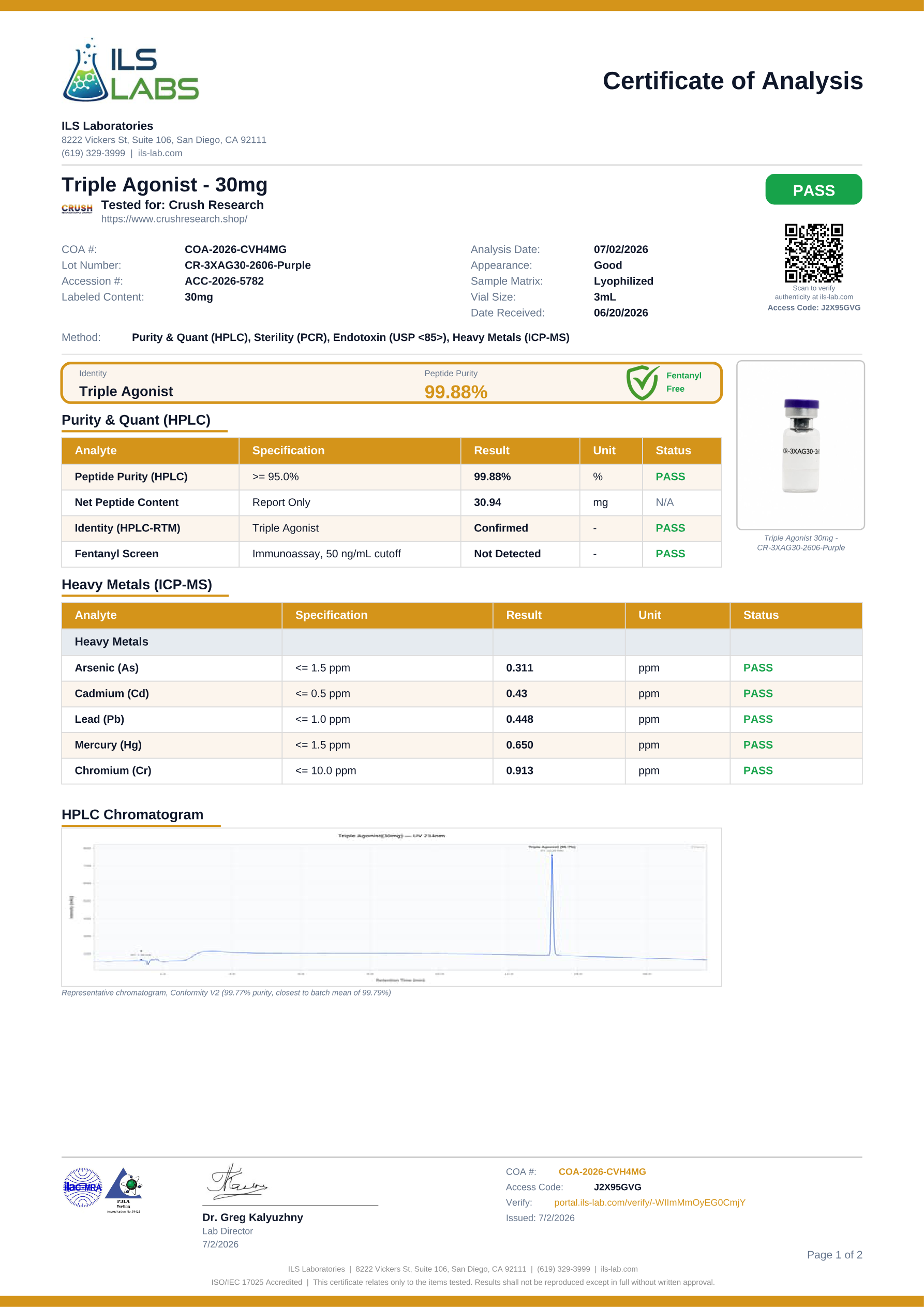
I don't know how exactly the labs quantify the heavy metals in the lyophilized powders, as a liquid or as a solid. Usually it is expressed in PPM, like here

or here

Interestingly, the max levels are different for different labs. See for Arsenic, 1.5 ppm vs. 0.01 ppm limit.
Take 1.5 ppm Arsenic limit, for example, for that 30 mg Reta vial. It is 1.5 ug per g for solid powders. We have a "puck" of maybe about 1000 mg there of something that may be contaminated with Arsenic. 30 mg of it is the primary component and the rest 970 mg of whatever the filler it is. I don't see COAs even list the total mass of the material they analyze, they only list those 30 mg of the active ingredient, completely ignoring the presence of the rest 970 mg of the filler, so we have to assume the total weight.
So, if you use 1 mg of Reta, it will be 1/30 of that total amount, say 33 mg of the powder roughly. At 1.5 ppm, it would contain up to 0.05 ug of Arsenic. The table from the document below allows up to 15 ug a day, so it is OK.
PPM may also mean ug/mL for liquids. If we use 3ml of liquid with this vial, then 1 mg will be 10 units or 0.1 ml. At 1.5 ppm (1.5 ug per 1 ml), it will be allowed to contain up to 0.15 ug of Arsenic. It's a different amount, but it is still less than 15 ug a day.
I guess the second computation looks better, but I still don't know if it's the right way to think about it.
The table

attentiion is all you need
-
I don't know how exactly the labs quantify the heavy metals in the lyophilized powders, as a liquid or as a solid. Usually it is expressed in PPM, like here
or here
Interestingly, the max levels are different for different labs. See for Arsenic, 1.5 ppm vs. 0.01 ppm limit.
Take 1.5 ppm Arsenic limit, for example, for that 30 mg Reta vial. It is 1.5 ug per g for solid powders. We have a "puck" of maybe about 1000 mg there of something that may be contaminated with Arsenic. 30 mg of it is the primary component and the rest 970 mg of whatever the filler it is. I don't see COAs even list the total mass of the material they analyze, they only list those 30 mg of the active ingredient, completely ignoring the presence of the rest 970 mg of the filler, so we have to assume the total weight.
So, if you use 1 mg of Reta, it will be 1/30 of that total amount, say 33 mg of the powder roughly. At 1.5 ppm, it would contain up to 0.05 ug of Arsenic. The table from the document below allows up to 15 ug a day, so it is OK.
PPM may also mean ug/mL for liquids. If we use 3ml of liquid with this vial, then 1 mg will be 10 units or 0.1 ml. At 1.5 ppm (1.5 ug per 1 ml), it will be allowed to contain up to 0.15 ug of Arsenic. It's a different amount, but it is still less than 15 ug a day.
I guess the second computation looks better, but I still don't know if it's the right way to think about it.
The table


Hello! It looks like you're interested in this conversation, but you don't have an account yet.
Getting fed up of having to scroll through the same posts each visit? When you register for an account, you'll always come back to exactly where you were before, and choose to be notified of new replies (either via email, or push notification). You'll also be able to save bookmarks and upvote posts to show your appreciation to other community members.
With your input, this post could be even better 💗
Register Login